
Stepping Away
How to Step Away From Your Business Without It Falling Apart

Picture this. You finally book the trip. Maybe it's a week in the mountains, maybe it's just a long weekend with your phone face down on the nightstand. And somewhere around day two, you catch yourself refreshing your inbox in the parking lot of a trailhead, because a client might need something and you're the only one who knows where it lives.
If you want to step away from your business and actually be gone, that moment is the problem worth solving. Not your work ethic, not your team, not your commitment. The problem is that the business still runs through you.
I run my business from wherever I happen to be, and I'll be honest: that freedom didn't come from working harder. It came from structure. So let's talk about what's really keeping you tethered, and the steps that loosen the grip, one system at a time.
Why stepping away feels impossible for most owners
You're not imagining it. Business owners rarely get a real break, even when they technically take time off.
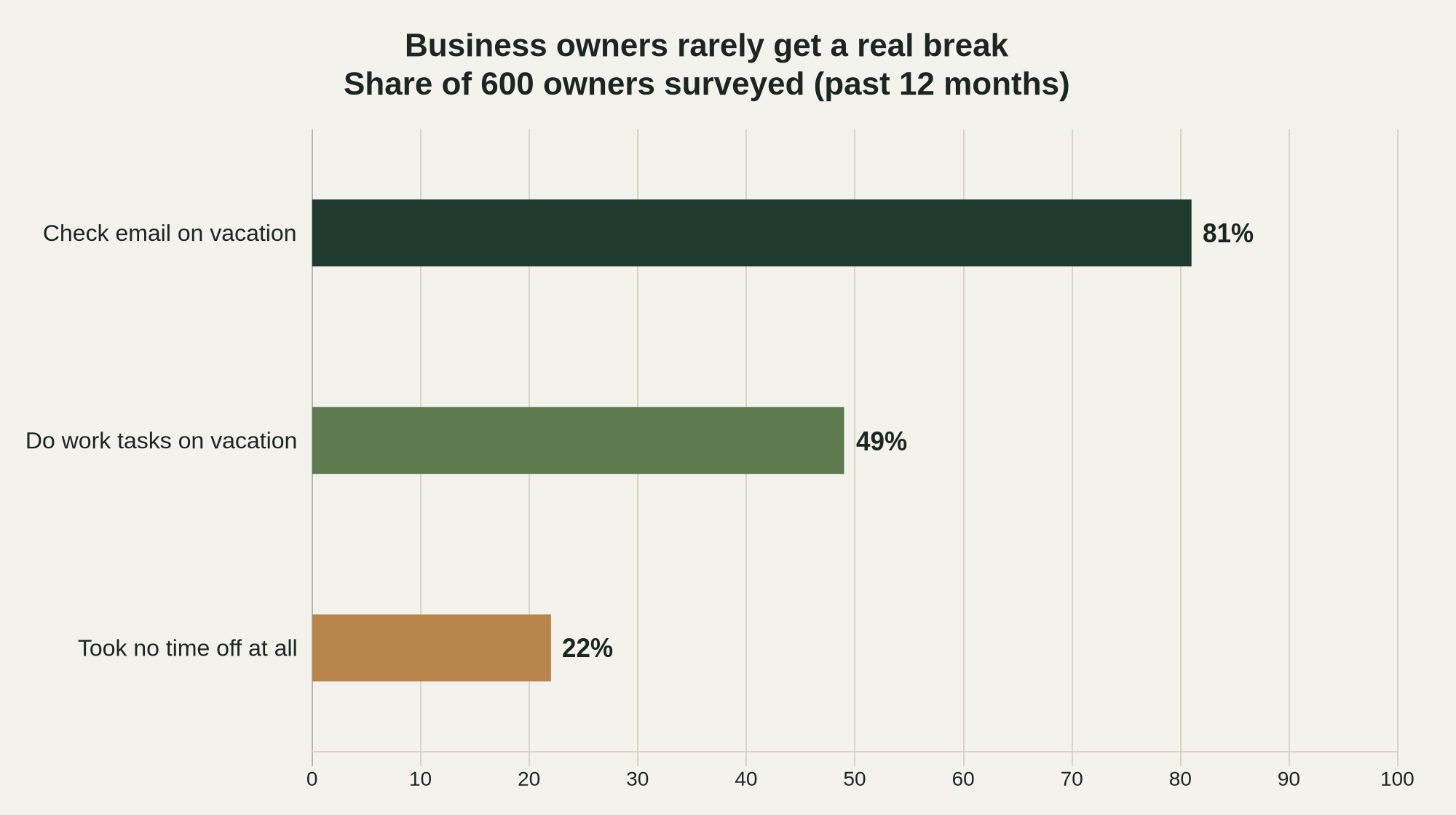
In a 2024 survey of 600 business owners by Clarify Capital, 22% said they took no time off at all in the past year. Of the ones who did get away, 81% still checked email on vacation, and 49% did actual work tasks while they were supposed to be off.
Source: Clarify Capital, The Business of Breaks: Time Off Report 2024 (600 business owners).
The same report found that 42% of owners pointed to not having a reliable person to keep things running as a reason they couldn't take time off. That's the real story here. It isn't that owners don't want rest. It's that nobody else knows how to do the things only they know how to do.
That's not a personality flaw. It's an operations gap, and operations gaps can be closed.
Where your hours actually go
Before you can hand anything off, it helps to see where your week is going. Most owners guess wrong, usually in the direction of "I'm mostly doing client work."
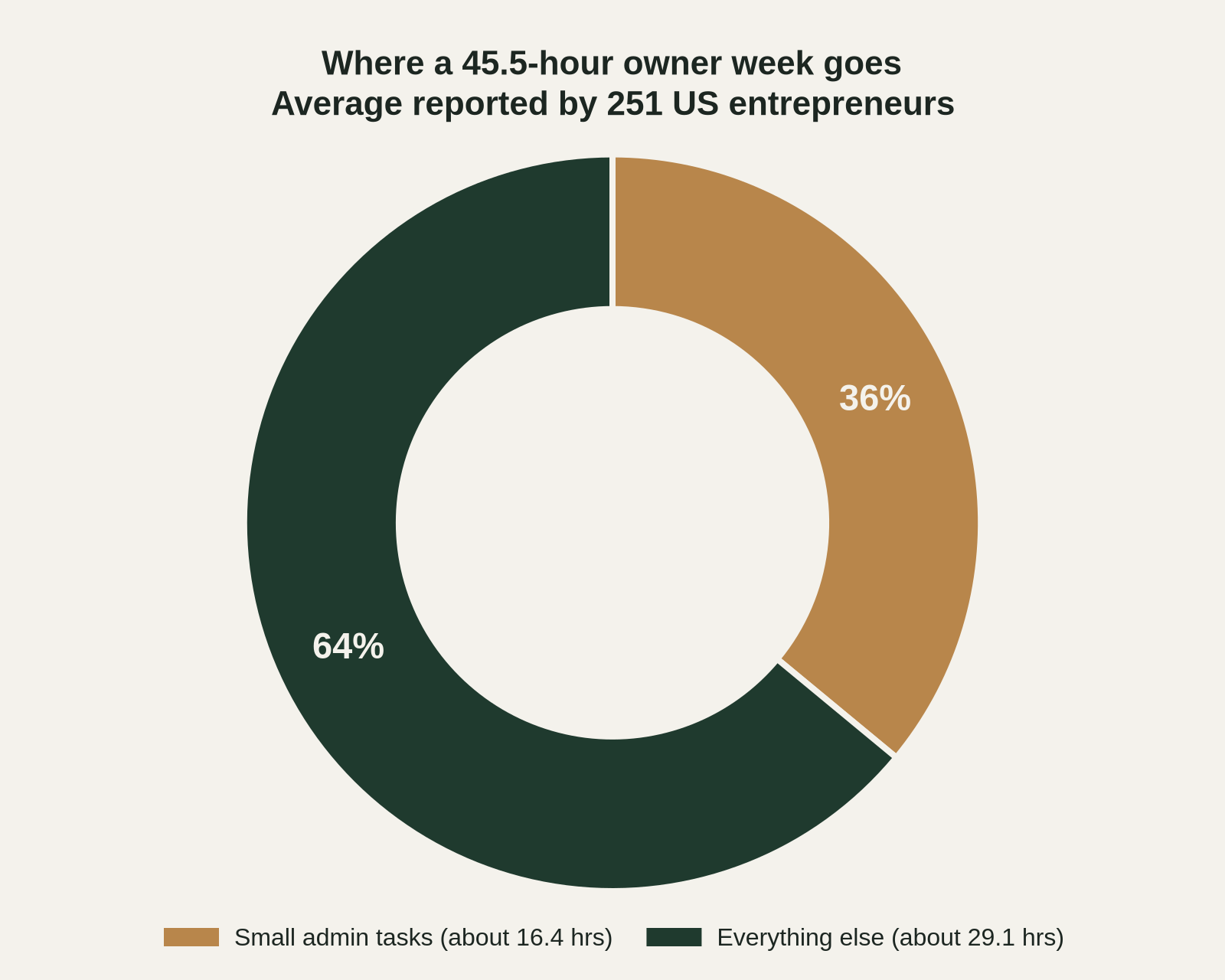
A survey of 251 US entrepreneurs by Time etc and Censuswide found the average owner works 45.5 hours a week and spends 36% of that time on small administrative tasks. Do the math and that's roughly 16 hours a week. Two full workdays, gone to tasks that don't need you.
Source: Time etc and Censuswide survey of 251 US entrepreneurs, September 2023. Hours are calculated from the reported 45.5-hour average week.
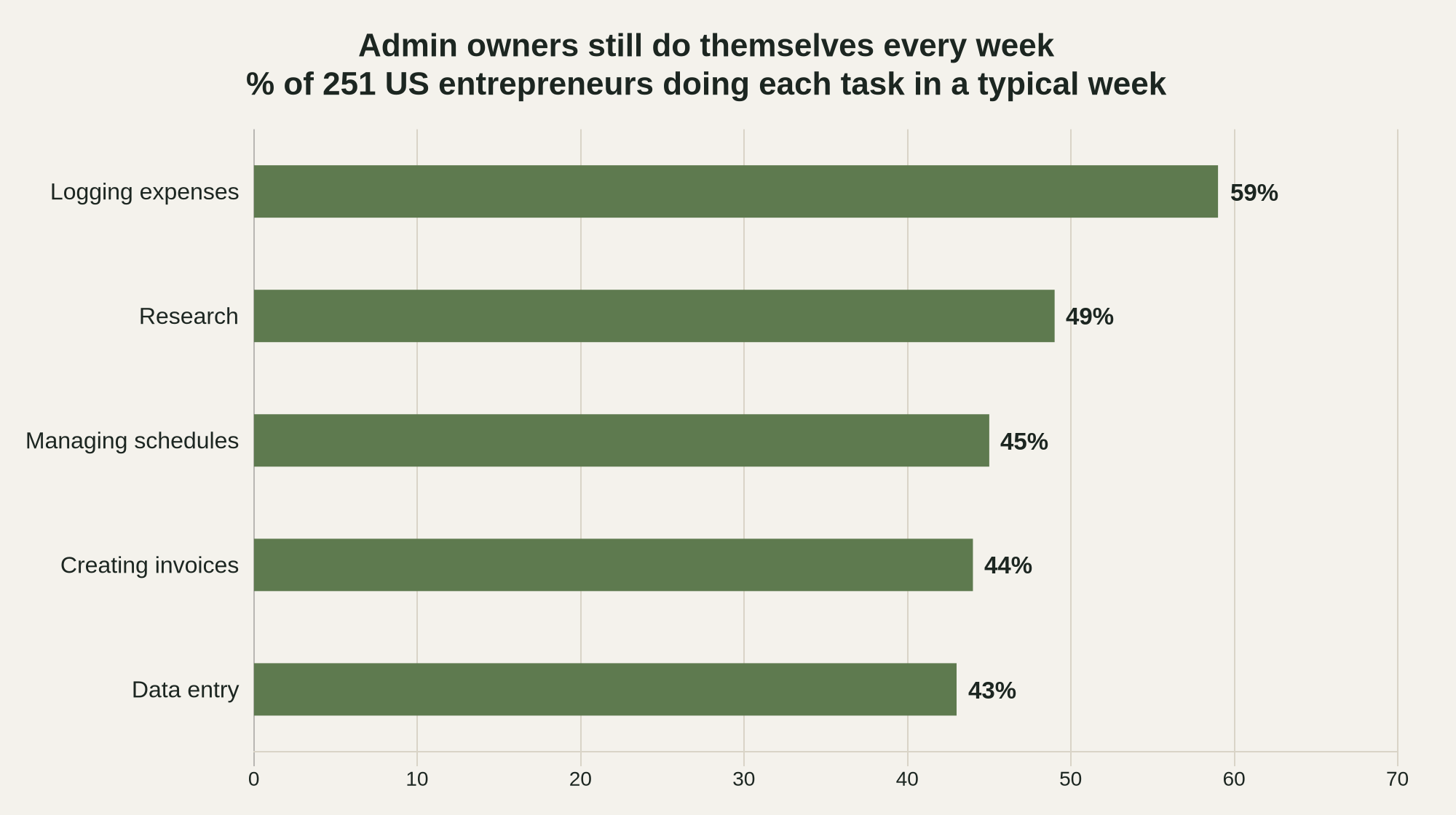
And it isn't one or two odd jobs. In a typical week, most owners in that survey were still personally handling the same handful of tasks:
Source: Time etc and Censuswide survey of 251 US entrepreneurs, September 2023.
Smaller businesses feel this even more. UENI's 2024 research on 837 US businesses with five or fewer employees found a median workweek of 60 hours, with 22.4% of owner time going to admin, legal and compliance.
Here's the part I want you to sit with. Every one of those tasks is a reason you check your inbox from the trailhead. And every one of them is something a system, a person, or a well-built automation can carry.
How to step away from your business in 5 steps
This is the order I'd walk through with a client. It works whether you're planning a two-week trip or simply want your evenings back.
1. Get what's in your head onto paper
For one week, keep a running list of every task you touch, every question someone asks you, and every "oh, I'll just do it" moment. Don't organize it yet. Just capture it.
At the end of the week, sort the list into three groups:
- Only I can do this (strategy, key client relationships, creative direction)
- Someone else could do this if they knew how (most of the list, usually)
- A tool could do this (reminders, data moving from one app to another, follow-ups)
That middle group is your roadmap. It's the stuff that keeps you tethered only because the knowledge lives in your head.
2. Write the SOPs that matter first
You don't need a 200-page operations manual. You need short, clear instructions for the handful of things that break when you're gone.

Photo: Pexels.
Start with the tasks from your "someone else could do this" list that come up most often. A good SOP answers four questions: what triggers this task, what are the steps, where do the files and logins live, and what does "done" look like. A quick screen recording with a few written notes is often enough to start. You can polish later.
Keep every SOP in one place your team can actually find, whether that's a shared drive, a Notion workspace, or the project tool you already use. A brilliant process nobody can locate does the same thing as no process at all: it sends the question straight back to you.
This is where most owners stall, because documenting feels slower than just doing it yourself. It is, the first time. The fifth time someone else handles it without asking you, it's the best hour you ever spent.
3. Hand off the admin first
Look back at that chart. Logging expenses, scheduling, invoicing, data entry. These are the tasks most owners still do themselves every week, and they're also the easiest to delegate well, because they follow clear rules.
Hand these to a VA, an assistant, or a bookkeeper before you try to delegate anything judgment-heavy. Early wins build trust on both sides, and trust is what lets you hand off bigger things later.
4. Let automation and AI carry the repeatable work
Once a task is documented, ask whether a person needs to do it at all. Plenty of the work that keeps owners busy is really just information moving from one place to another: a form submission that should become a client folder, an invoice that should trigger a reminder, a booked call that should send a welcome email.
AI can help here too, with drafting responses, summarizing calls, and sorting what needs attention. The key is keeping a human in the loop for anything that touches a client relationship or a real decision. AI assists, you decide. That balance is what lets you trust the system enough to stop checking on it.
If you're not sure what's worth automating in your business, an AI Opportunity Audit is built for exactly that question.
5. Run a test away

Photo: Kristi Jacobsen.
Before the big trip, take a practice day. Block one full workday where you are completely unavailable, and let the business run on what you've built.
Then pay attention to what comes up. Every question that lands while you're gone is a gap in a system, not proof that you can't step away. Fix those gaps, then try two days. Then a long weekend. You're building evidence, for yourself and your team, that the business can hold its shape without you in the middle of it.
Signs you're ready to step back
You don't need everything perfectly documented before you take time off. You need enough in place that the most likely problems have an answer. A few signs you're closer than you think:
- Your team asks fewer "where is" questions. When files, logins and templates live in one shared place, people stop needing you to find things.
- The same issue doesn't reach you twice. If a question comes up, gets answered, and turns into a written step, the system is learning.
- Client communication has a rhythm. Clients know when they'll hear from your business and who they'll hear from, so a few quiet days from you don't feel like a red flag to them.
- You can name your backup. For every critical task, there's a person or a tool who handles it when you're out, and they've done it at least once.
- You know what counts as urgent. You and your team have agreed on what's worth interrupting your time off for, and it's a short list.
If you can check three of those, you're ready for a test day. If you can check all five, book the trip.
What stepping away doesn't mean
Stepping away isn't checking out of your business or caring less about your clients. Done well, it means the opposite. Your clients get a business that responds consistently whether or not you're online, and you come back with more energy for the work only you can do.
It also isn't all or nothing. Some owners want to disappear for a month a year. Others just want to stop answering email at 9 PM. Both are valid, and both start with the same move: getting the business out of your head and into systems other people can follow.
Structure isn't what ties you down. It's what lets you leave.
Find out how close you are
If you're wondering how much your business still depends on you, I built a quick way to find out. The Step-Away Score is a 10-question quiz that takes about three minutes and shows you where you're stuck across time, systems, delegation, AI and automation.
Take it, see your score, and you'll know exactly which of the five steps above to start with. And if you'd rather talk it through, you can always book a discovery call and we'll map it out together.
FAQ
How do I step away from my business without it falling apart?
Start by getting what lives in your head onto paper, then write short SOPs for the tasks that break when you're gone. Hand off routine admin first, automate the repeatable work with a human still reviewing anything client-facing, and run a practice day away before a longer trip.
How long does it take to get a business ready to run without the owner?
It depends on how much is documented today. Most owners can be ready for a test day within a few weeks if they focus on their most frequent tasks first. Longer breaks come from repeating that cycle: step away, notice what comes up, and turn each gap into a written step.
What should I delegate first as a business owner?
Start with rule-based admin like logging expenses, scheduling, invoicing and data entry. In a Time etc and Censuswide survey of 251 US entrepreneurs, these were among the tasks owners most often still did themselves each week, and they are the easiest to hand off well.
Can AI help me take time off from my business?
Yes, for repeatable work like drafting responses, summarizing calls, routing requests and moving information between tools. Keep a person in the loop for anything that affects a client relationship or a real decision, so you can trust the system without checking on it.